The average attacker remains inside a network for 207 days before being detected. By the time an alert appears, they've often mapped your environment, identified critical assets, and established persistence. That's why the CrowdStrike vs. Microsoft Defender debate is more than a procurement decision it's about how quickly you can detect, investigate, and stop threats already inside your network. This blog breaks down the key differences.
Table of Contents
First Some Numbers That'll Change How You Think About This
Before we pit these two giants against each other, let's set the stage with some facts from 2025–2026:
- $4.88 million The average cost of a data breach in 2024 (IBM Security Report). It hit a record high for the third consecutive year.
- 71% of breaches involved compromised credentials. Your endpoint tool needs to see identity, not just files.
- The CrowdStrike July 2024 outage took down 8.5 million Windows machines in under 2 hours a stark reminder that your security vendor IS your attack surface.
- Microsoft processes 78 trillion security signals per day across its cloud. That's a staggering intelligence advantage when it works for you.
- Companies with fully deployed security AI saved an average of $2.22 million per breach compared to those without it.
Why This Comparison Still Matters in 2026 ?
The endpoint security market has matured significantly over the last few years. We've moved well past basic antivirus (AV) and signature-based detection. Today, the conversation is about:
- Extended Detection and Response (XDR) across endpoints, identity, cloud, and network
- AI-powered threat detection with behavioural analytics
- Threat intelligence integration and real-time IOC feeds
- SOC integration how well these tools feed into your Security Operations Centre workflow
- MTTD and MTTR Mean Time to Detect and Mean Time to Respond, the metrics that actually matter during an incident
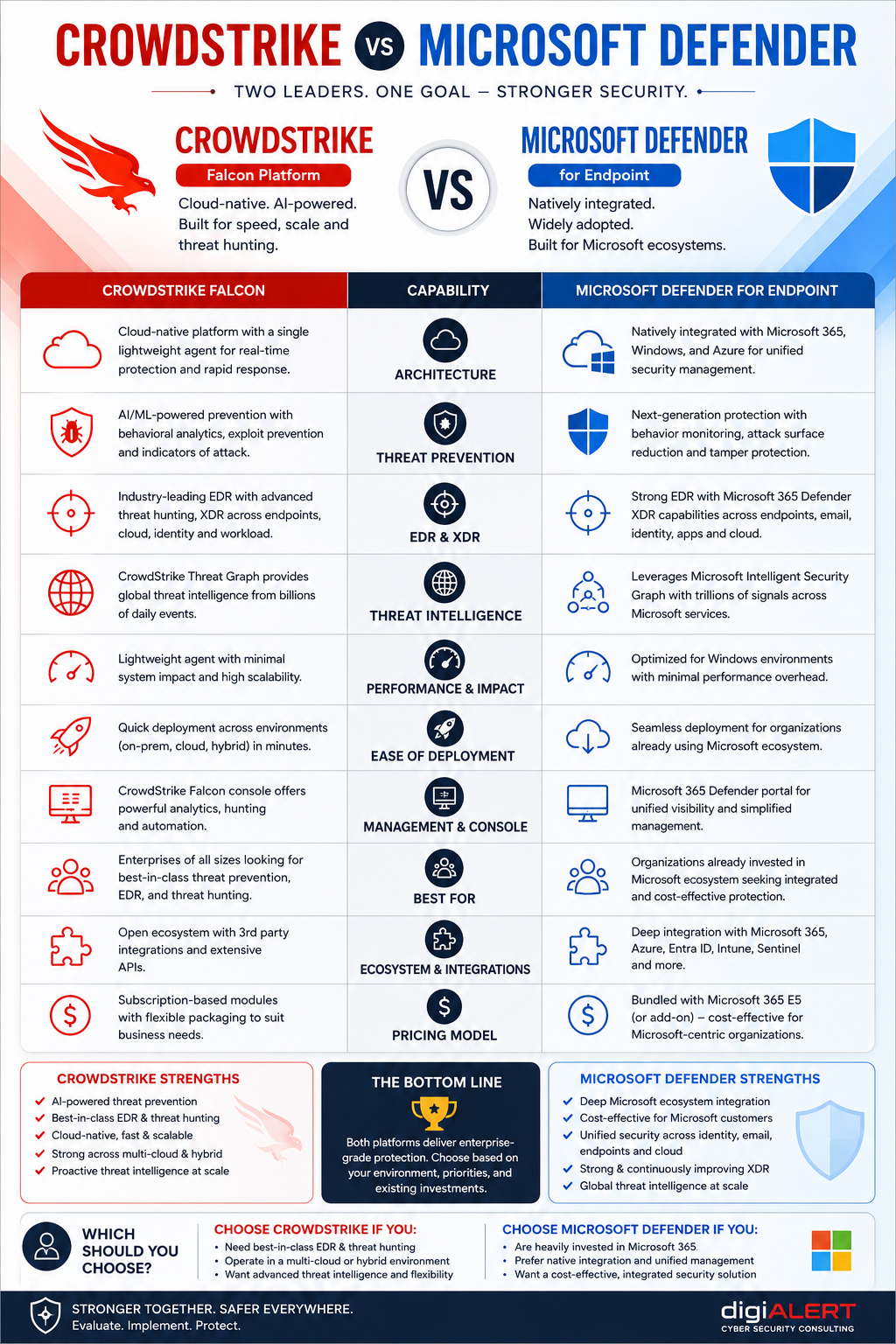
CrowdStrike and Microsoft Defender sit at the very top of the enterprise EDR/XDR conversation. The Gartner Magic Quadrant consistently places both in the Leaders quadrant. But their philosophies, architectures, and total cost of ownership are fundamentally different and that gap shapes your security posture more than most people realize.
CrowdStrike Falcon: What You're Actually Getting
CrowdStrike was built on one radical idea the real threat isn't the malware, it's the human operating it. Every feature in the Falcon platform flows from that thinking.
What Falcon Provides :
- Falcon Prevent
- Falcon Insight XDR
- Falcon Intelligence
- Falcon OverWatch
- Falcon Identity Protection
- Falcon Complete
Strengths
- Independently verified detection. 99%+ coverage in MITRE ATT&CK 2025 Evaluations tested by a neutral third party not a vendor slide deck.
- Adversary intelligence that changes how you respond. Knowing your alert matches a specific nation-state group turns a routine ticket into an executive escalation. No other platform does this natively at this depth.
- Consistent cross-platform coverage. Equal depth on Windows, macOS, Linux, and cloud. No weak spots for mixed environments.
- Speed is a design principle. The 1-10-60 standard detect in 1 min, investigate in 10, contain in 60 is baked into how Falcon prioritizes every alert.
Weaknesses
- Premium pricing. Core EDR runs $15–$25/endpoint/month. Full platform with Intelligence, Identity, and Cloud Security pushes $35–$50. For 10,000 seats, you're looking at $4–6M annually.
- Rewards skilled operators. Falcon is a precision instrument. Junior or lean security teams frequently underutilize what they're paying for.
- The July 2024 outage. A faulty update took down 8.5 million Windows machines globally in hours. CrowdStrike has since strengthened update controls, but for critical infrastructure environments, it remains a real architectural conversation
![crowdstrike vs microsoft defender]()
Microsoft Defender: What You're Actually Getting
Don't let the "free Windows tool" reputation fool you. The 2026 version of Microsoft Defender is a full-stack enterprise XDR platform and the integration story is something no competitor can replicate.
What Defender Provides:
- Defender for Endpoint (Plan 2)
- Microsoft Defender XDR
- Microsoft Sentinel
- Defender for Identity
- Defender for Office 365
- Microsoft Security Copilot
Strengths
- You might already own it. Microsoft 365 E5 includes Defender for Endpoint Plan 2, Defender XDR, Defender for Identity, and Sentinel. Many enterprises are paying $20+/endpoint for third-party EDR while this sits unused in their licensing.
- Native XDR correlation nobody else can match. Phishing email → credential compromise → lateral movement → data exfiltration. That entire chain surfaces as one connected incident automatically. Third-party tools approximate this with connectors. It's not the same.
- Automated containment that moves fast. AIR can quarantine a device, revoke active sessions, and block malicious files tenant-wide without a human touching anything. In ransomware scenarios, those first automated minutes matter enormously.
- Built-in compliance. ISO 27001, PCI DSS, HIPAA, DPDPA compliance dashboards, audit logs, and data classification are structurally native, not bolted on afterward.
Weaknesses
- Licensing complexity is a real tax. E3, E5, E5 Security, E5 Compliance, Business Premium understanding exactly what you have and what you're missing requires dedicated effort. Organizations regularly discover gaps they assumed were covered.
- Noisy out of the box. Without proper tuning, Defender buries analysts in alerts. The platform rewards configuration investment but that takes time and expertise most teams underestimate.
- Thinner outside the Microsoft ecosystem. macOS and Linux coverage exists but lacks the depth of Windows. Heavy AWS environments and open-source Linux shops will feel the gaps.
- Threat intelligence depth lags CrowdStrike. MSTIC produces solid intelligence, but named adversary tracking, geopolitical attribution, and campaign-level context is measurably richer in Falcon Intelligence.
Secure Your Enterprise with digiALERT's SOC 24×7 Monitoring
What digiALERT SOC brings to your CrowdStrike or Microsoft Defender deployment:
1. 24×7×365 SOC Monitoring Dedicated analysts watching your environment day and night, across all time zones, with zero alert fatigue gaps
2. Platform-Agnostic SIEM Integration We work with your existing stack. CrowdStrike Falcon, Microsoft Sentinel, Splunk, Wazuh our SOC correlates across all of them
3. Threat Hunting Proactive adversary hunting beyond automated detection, mapped to MITRE ATT&CK frameworks
4.Incident Response & Containment Rapid response with documented playbooks for ransomware, BEC, data exfiltration, and insider threats
5.Vulnerability Management Continuous prioritization aligned to your threat profile, not just CVSS scores
6.Compliance Monitoring DPDPA, CERT-In, ISO 27001:2022, PCI DSS, HIPAA, and SOC 2 aligned controls and reporting
7. AI Red Teaming Testing your AI-powered tools against adversarial attacks before threat actors do
Ready to see how digiALERT SOC 24×7 Monitoring integrates with your CrowdStrike or Microsoft Defender environment?
👉 Book a Free SOC Assessment with digiALERT
FAQ :
1. What operating systems does CrowdStrike support?
Falcon supports Windows (desktop and server versions including Windows 11, 10, 8.1, Windows 7 SP1, Server 2025 through 2008 R2), macOS, Linux, ChromeOS, iOS, and Android. Legacy systems like Windows XP and Server 2003 are supported through Falcon for Legacy Systems
2. Is CrowdStrike suitable for small businesses?
The Falcon Go plan at $5/device/month made it more accessible, but full EDR deployments at $15+/device still cost 3–4x more than alternatives like Bitdefender or ESET. You pay for detection quality
3. Does Microsoft Defender work on Linux?
Yes, Defender for Endpoint on Linux is updated regularly with security fixes included in monthly releases. However, starting with version 101.24082.0004, it no longer supports the Auditd event provider.