Cyber threats are increasing in both frequency and sophistication, making 24/7 security a business necessity. Managed Security Services help organizations monitor, detect, and respond to threats proactively. In this blog, we'll explore how they work and how to choose the right Managed Security Service Provider (MSSP) for your business.
What Is a Managed Security Service?
A Managed Security Service is an outsourced cybersecurity service that helps businesses monitor, detect, investigate, and respond to security threats.
Instead of building and operating an entire security operations team internally, an organisation works with an external security provider that supplies the required technology, security analysts, processes, and expertise.
A typical Managed Security Service may include:
- 24/7 security monitoring
- Security Operations Centre support
- SIEM implementation and management
- Endpoint security monitoring
- Cloud security monitoring
- Threat detection and investigation
- Vulnerability management
- Incident response support
- Firewall and network security management
- Security reporting
- Compliance monitoring
- Threat intelligence
The exact scope depends on the provider, your infrastructure, your risk profile, and the Managed Security Service package you choose.
For example, a small business may need endpoint monitoring, firewall monitoring, and basic incident escalation. A larger organisation may require advanced threat hunting, cloud workload monitoring, custom detection rules, compliance dashboards, and a dedicated incident response process.
What Does a Managed Security Service Provider Do?
A Managed Security Service Provider acts as an extension of your internal IT or cybersecurity team.
The provider collects security data from systems such as:
- Laptops and desktops , Servers, Firewalls, Cloud platforms, Identity platforms etc .
The provider then analyses this information to identify suspicious behaviour.
For example, imagine that an employee’s account logs in from Chennai at 10:00 a.m. and then appears to log in from another country 20 minutes later. A properly configured Managed Security Service should identify the impossible travel pattern, investigate the account activity, and escalate or contain the incident based on predefined procedures.
A mature MSSP does more than send an automated email stating that an alert occurred. Its analysts should determine whether the activity is genuinely malicious, explain the business impact, and tell your team what must happen next.
Why Do Businesses Use Managed Security Services?
The main reason is simple: cybersecurity has become too complex to manage with limited internal resources.
Most IT teams are already responsible for infrastructure, applications, user support, cloud platforms, backups, and business continuity. Expecting the same team to continuously monitor thousands of security events is rarely practical. Businesses commonly invest in a Managed Security Service for the following reasons.
- To Gain 24/7 Security Monitoring
Threat actors operate across time zones. A security incident that begins at 2:00 a.m. can cause significant damage before employees arrive at work. A 24/7 SOC monitoring service provides continuous visibility into suspicious activity and critical security events.
However, buyers should confirm whether “24/7 monitoring” means real human analysts are actively monitoring the environment or whether the provider is only using automated alerting.
That distinction matters.
- To Access Experienced Cybersecurity Professionals
Recruiting and retaining SOC analysts, security engineers, incident responders, and threat hunters can be expensive. A Managed Security Service gives businesses access to a broader team of professionals without requiring them to hire every specialist internally.
This is particularly valuable for organisations that do not have a dedicated Chief Information Security Officer or a mature security team.
- To Reduce Alert Fatigue
Security platforms can generate hundreds or thousands of alerts every day. Many of these alerts are duplicates, low-risk events, or false positives. A capable MSSP should filter, prioritise, investigate, and contextualise alerts before escalating them.
Your team should receive meaningful incidents, not an unmanageable inbox full of raw notifications.
- To Improve Incident Response
Detecting a threat is only the first step. The real question is what happens after detection. A Managed Security Service should provide clearly defined incident response procedures covering:
- Alert validation, Incident classification, Business impact assessment, Evidence collection ,Root cause analysis, Remediation guidance, post-incident reporting. The faster a threat is investigated and contained, the lower the potential business impact.
- To Support Compliance Requirements
Organisations may need to demonstrate security monitoring and incident management under frameworks and regulations such as:
- ISO 27001
- SOC 2
- PCI DSS
- HIPAA
- GDPR
- DPDPA
- RBI cybersecurity requirements
- Industry-specific security standards
A Managed Security Service can help centralise security logs, retain evidence, document incidents, produce reports, and demonstrate that security controls are operating consistently.The provider does not automatically make your business compliant, but it can support several technical and operational compliance requirements.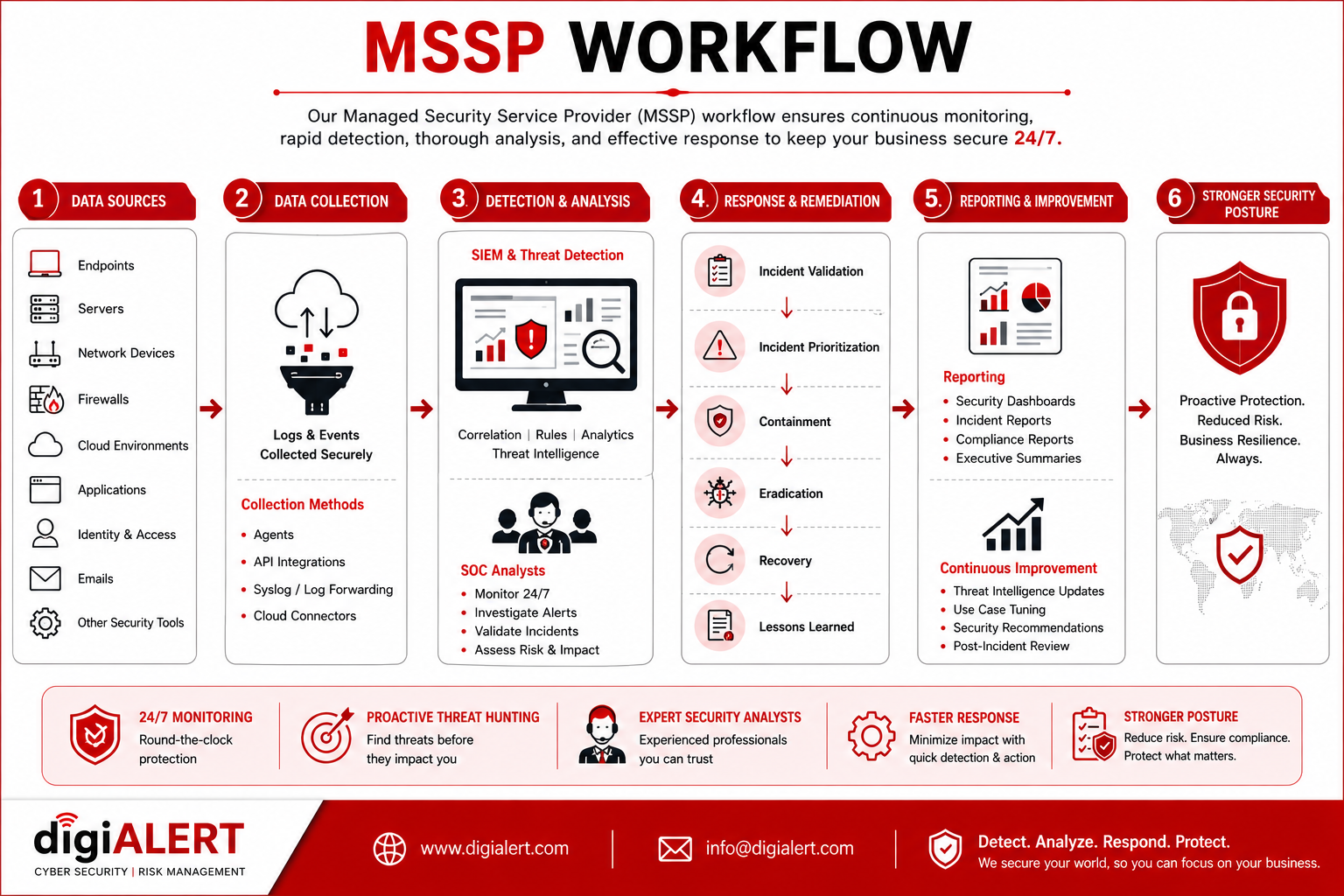
Managed Security Service vs In-House Security Team
This is not always an either-or decision.Larger companies may have both an internal security team and an MSSP. The internal team understands the organisation’s applications, users, business priorities, and risk appetite. The Managed Security Service Provider supplies continuous monitoring, specialised expertise, technology management, and additional operational capacity.
For smaller businesses, outsourcing may be more practical than building a full Security Operations Centre.
An in-house security team may provide:
- Stronger understanding of internal business context
- Direct control over security operations
- Faster coordination with internal departments
- Custom processes built around the organisation
A Managed Security Service may provide:
- Broader cybersecurity expertise
- Continuous monitoring
- Access to mature security processes
- Faster service deployment
The right model depends on your organisation’s size, existing security capability, risk exposure, regulatory obligations, and budget.
What Should a Managed Security Service Include?
Before comparing providers define what you need.Buying a long list of security features without understanding your risks can result in unnecessary costs and weak outcomes. A strong Managed Security Service should usually include the following components.
Security Monitoring
The provider should monitor relevant security data across your endpoints, network, cloud platforms, identities, and critical applications.Ask exactly which systems will be monitored. Do not assume that every cloud account, branch office, application, or endpoint is included.
SIEM Management
A Security Information and Event Management platform collects and correlates logs from different systems. A SIEM platform alone is not a Managed Security Service. Without proper configuration and continuous investigation, it becomes an expensive log storage system.
Threat Detection and Investigation
The provider should investigate alerts and distinguish real threats from false positives. Providers that depend entirely on default vendor rules may miss attacks specific to your environment.
Incident Response
The service agreement should clearly state what the MSSP will do during an incident.Some providers only notify the client. Others can isolate an endpoint, disable an account, block an IP address, or assist with forensic investigation.You need to know where the provider’s responsibility ends and where your internal team’s responsibility begins.
Vulnerability Management
Some Managed Security Service packages include vulnerability scanning, prioritisation, reporting, and remediation tracking.Make sure the provider does not simply deliver a long list of vulnerabilities without explaining which ones create the highest business risk.Prioritisation should consider exploitability, exposure, asset criticality, available exploits, and business impact.
Reporting and Governance
Reports should help management understand risk, not just display technical statistics.Executives need a clear view of whether the organisation’s security posture is improving.
How Much Does a Managed Security Service Cost?
Managed Security Service pricing varies based on several factors:
- Number of endpoints
- Number of users
- Number of servers
- Number of locations
- Cloud environments
- Security data volume
- Events per second
- Log retention period
- Monitoring coverage
- Incident response requirements
- Compliance reporting needs
- Existing security tools
- Level of customisation
Providers may charge per user, endpoint, device, log source, data volume, or service package. Do not compare prices without comparing scope.One provider may offer a lower monthly cost but exclude cloud monitoring, incident response, vulnerability management, or long-term log retention. Another may appear more expensive while covering significantly more of your environment.
The more useful question is not, “Which MSSP is cheapest?”It is, “Which provider can reduce our security risk without creating operational gaps?”
Is a Managed Security Service Right for Your Business?
A Managed Security Service may be suitable when:
- You do not have a dedicated 24/7 SOC
- Your IT team is overwhelmed by security alerts
- You are expanding into cloud environments
- You need stronger incident detection and response
- You are preparing for ISO 27001, SOC 2, PCI DSS, DPDPA, or another compliance requirement
- You have limited internal cybersecurity expertise
- Your existing security tools are not being fully utilised
- Management needs better visibility into cyber risk
- Your customers expect stronger security controls
- You need predictable cybersecurity operating costs
The decision should follow a security assessment, not a sales presentation.Start by identifying your critical assets, existing controls, security gaps, business risks, and regulatory requirements. Then evaluate which parts should remain internal and which can be handled more effectively by a specialised provider.
Frequently Asked Questions
What is the difference between an MSSP and an MDR provider?
An MSSP traditionally manages a broader range of security services, including SIEM, firewalls, vulnerability management, compliance reporting, and monitoring. Managed Detection and Response focuses more specifically on threat detection, investigation, threat hunting, and incident response. In practice, the services often overlap. Buyers should examine the actual scope instead of relying only on the service label.
Does a Managed Security Service replace an internal IT team?
No. A Managed Security Service normally supports the internal IT or security team.
The MSSP monitors security events and provides specialist capabilities, while the internal team manages business systems, users, remediation activities, and organisational decisions. Responsibilities should be clearly documented.
What is 24/7 SOC monitoring?
24/7 SOC monitoring means security events are continuously monitored throughout the day, including weekends and holidays.
Buyers should verify whether qualified analysts are actively available at all times or whether after-hours monitoring relies primarily on automated alerts.
Does a Managed Security Service help with compliance?
Yes, it can support compliance by providing continuous monitoring, centralised logging, incident documentation, evidence retention, vulnerability reporting, and security metrics.
However, an MSSP does not automatically make an organisation compliant. Policies, risk assessments, employee training, governance, legal obligations, and internal controls may still need to be addressed separately.
What should be included in an MSSP contract?
The agreement should cover the service scope, covered assets, responsibilities, exclusions, SLAs, escalation procedures, data handling, log retention, reporting, incident support, pricing, termination terms, and data return or deletion requirements.
When should a business consider changing its MSSP?
Consider reviewing your provider when alerts are repeatedly missed, investigations lack detail, reports provide no business value, response times are poor, the service cannot support your technology stack, or the provider is unwilling to adapt as your risks change.
How digiALERT Protects Your Business ?
At digiALERT, we deliver more than just security alerts. Our Managed Security Services provide 24/7 threat monitoring, incident investigation, SIEM management, vulnerability management and expert guidance to help your organization detect, respond to and mitigate cyber threats. With proactive monitoring and actionable insights, we help strengthen your overall security posture and reduce business risk.